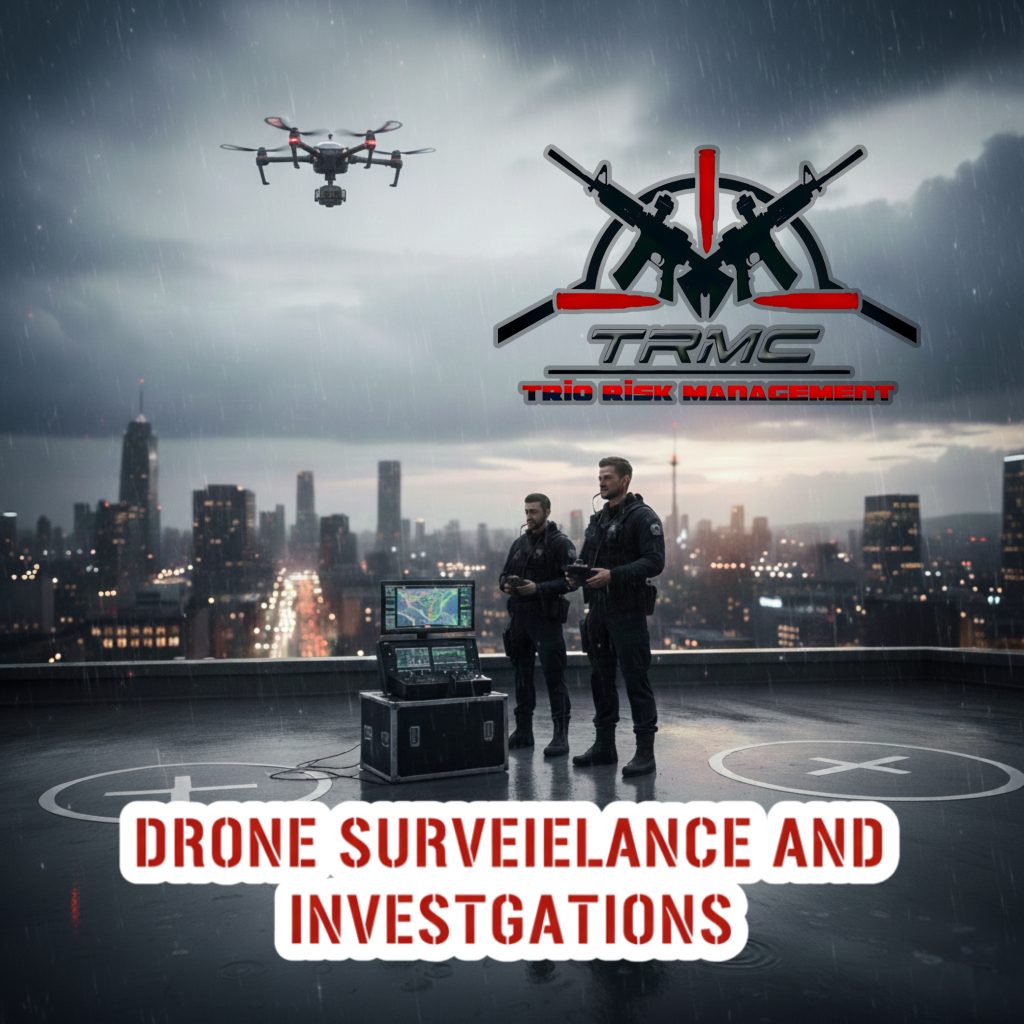

With the increasing need for automation, drone security systems have gained a substantial amount of popularity. Drone security guards have gained more attraction with customers attempting to reduce the cost of human guards in addition to improving efficiency. There are higher inquiries for drone security systems because drones provide a substantial amount more reliability than the human factor. However, the human factor cannot be eliminated entirely, but with drone technology, less personnel is needed, and they can work remotely. Business owners have started exploring the superiority and ingenuity that drone patrol security and systems offer, with less labor needed and increased efficiency and accuracy. Trio Risk also specializes in providing security surveillance operations resulting in detection of criminal activity with our fully trained license operators.
The shift toward Drone Security Systems marks a significant evolution in South African private security. By integrating unmanned aerial vehicles (UAVs) into traditional guarding models, Trio Risk Management bridges the gap between static human observation and high-speed, 360-degree aerial surveillance.
1. The Drone VS Human Guarding Dynamic
While human guards are limited by physical terrain, fatigue, and line-of-sight, drones provide a force multiplier effect. This doesn’t replace the human factor; it elevates it to a remote, tactical oversight role.
| Feature | Human Guarding | Drone Security Systems |
| Field of View | Restricted to ground level. | 360-degree aerial perspective. |
| Response Speed | Limited by terrain/distance. | Rapid “as-the-crow-flies” deployment. |
| Risk Profile | High (physical vulnerability). | Low (remotely operated). |
| Night Vision | Limited to flashlights/torches. | Advanced Thermal & Infrared sensors. |
| Cost Efficiency | High labor/overtime costs. | Scalable with fewer personnel. |
2. Core Capabilities of Trio’s Drone Operations
Trio Risk Management utilizes licensed operators to provide a level of surveillance that traditional systems cannot match:
- Thermal Imaging & Heat Mapping: Essential for South African night operations. Drones can detect the heat signature of an intruder hiding in thick brush or behind a warehouse long before they are visible to a ground patrol.
- Geofencing & Automated Patrols: Drones can be programmed to fly “waypoints”—pre-determined paths around a perimeter—at set intervals, ensuring 100% patrol consistency.
- Tactical Interception: In the event of a breach, a drone can “shadow” a suspect from a safe distance, providing live GPS coordinates to ground units without putting a human guard in harm’s way.
- Deterrence Factor: The audible and visual presence of a drone is a psychological deterrent, signaling to potential intruders that the site is monitored with high-tech capabilities.
3. Efficiency and Remote Oversight
The “Ingenuity” mentioned lies in the Remote Operations Center (ROC). Instead of ten guards patrolling a large farm or industrial park, you may only need two:
- The Pilot/Operator: Controls the UAV and monitors the live telemetry.
- The Tactical Responder: Remains on standby to intercept once the drone identifies a threat.
This setup significantly reduces the “Human Factor” error (such as falling asleep or missing a detail due to fatigue) and ensures that the response is always intelligence-led.
4. Legal & Compliance Note
Operating security drones in South Africa requires more than just hardware. Trio Risk Management ensures:
- ROC Licensing: Adherence to South African Civil Aviation Authority (SACAA) regulations.
- Certified Pilots: Operators are fully trained in both flight mechanics and tactical surveillance.
- Data Privacy: Ensuring surveillance complies with POPI Act regulations regarding the recording of public or neighboring spaces.